
Aldi set out to make its MAMIA kids' snack packaging look like the market leader's, but not so much that it would break the law. It misjudged the line. On 19 August 2026 the Full Federal Court found that five MAMIA packs infringed copyright in the packaging for the BELLIES range of children's snacks. That is two more than the trial judge found. The court also left the finding that Aldi's conduct was flagrant, and liable for additional damages, in place.
If you sell a product on a shelf or online, this decision is worth ten minutes of your time. It shows how far copyright in your packaging artwork reaches without any registration at all, where it stops, and how quickly "benchmarking" a competitor turns into infringement.
What this covers
- What happened between Aldi and the owners of the BELLIES brand, and what the Full Court decided
- What copyright protects in packaging, and what it does not
- Practical steps for brand owners, and for founders who want their product to sit comfortably next to a category leader
What happened
Hampden Holdings and Lacorium Health own the BELLIES range of baby and toddler snacks, sold as BABY BELLIES, LITTLE BELLIES and MIGHTY BELLIES. The packs were designed by an outside design studio. Each has a white background, real food photography, a rounded, playful font and a small orange "monster" with the brand name in a cream circle on its belly.
In 2019, Aldi briefed its design agency to refresh its own MAMIA snacking range. BELLIES packs appeared on a page headed "BENCHMARK" in the agency's presentation. Aldi's brief said the range "needs to follow Baby Bellies with real photography." When one draft came back, the feedback was that it was "too close to our benchmark," and it was toned down slightly. The trial judge found that Aldi's aim was packaging that resembled the BELLIES range, but not too closely, since that would infringe the law.
Hampden sent letters of demand. Aldi kept using the packaging for some months afterwards. Hampden sued for copyright infringement over eleven MAMIA packs. Aldi claimed in response that Hampden's letters were unjustified threats.
At trial, the court found that Aldi's three baby puffs packs infringed. The other eight packs (rice cakes, fruit and oat bars, and cereal bars) did not. The court found the infringement flagrant, held Aldi liable for additional damages and dismissed the unjustified threats claim. Aldi appealed. Hampden cross-appealed on the packs that had been cleared.
What the Full Court decided
Both sides partly won. Overall, Aldi went slightly backwards:
- The three puffs packs still infringe, but each one infringes only the matching BELLIES pack (blueberry with blueberry, carrot with carrot and so on), not every BELLIES puffs pack as the trial judge had found.
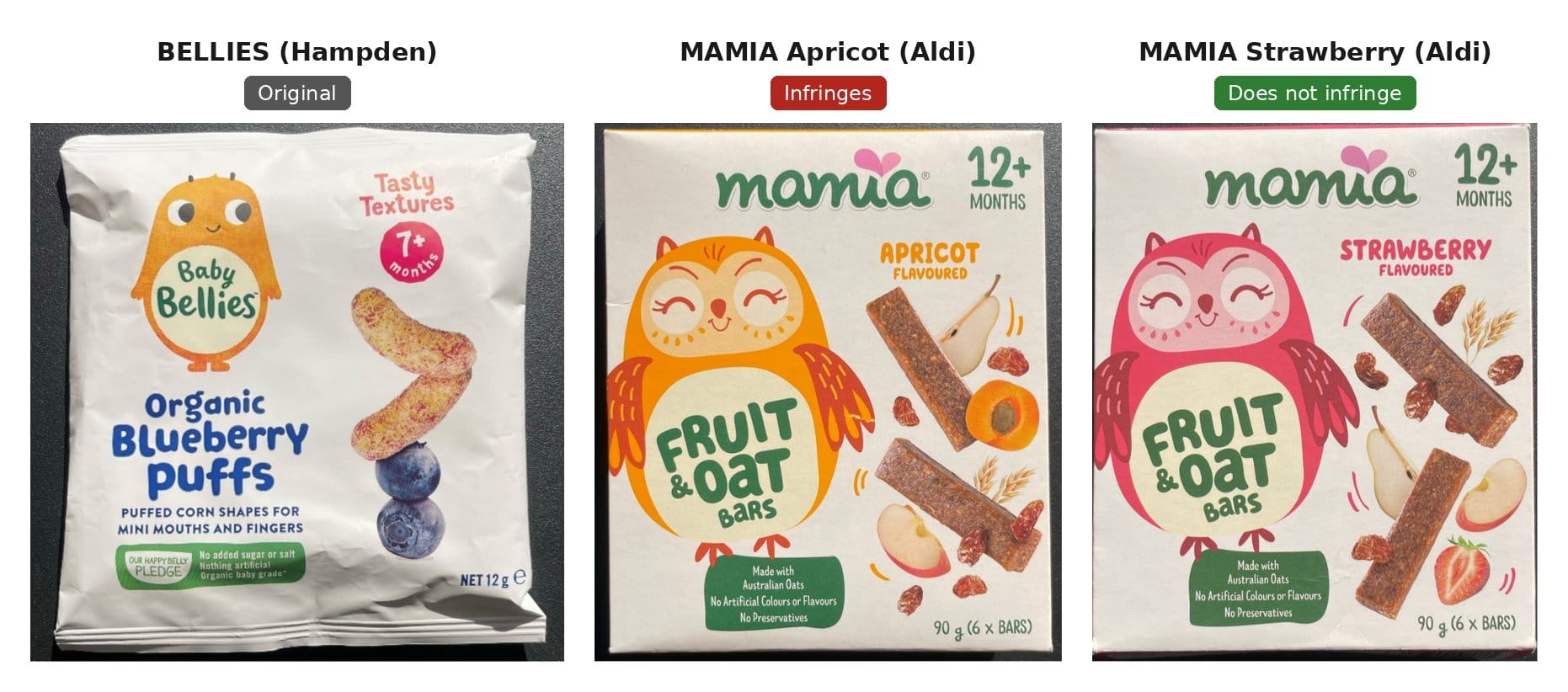
- Two more packs infringe. An apricot fruit and oat bar pack and an apple, blueberry and banana cereal bar pack were found to infringe the BELLIES blueberry puffs pack. The court described both as "(just)" enough to infringe.
- Six packs were cleared. In several cases the difference came down to details like the colour of Aldi's owl mascot, or the absence of blueberries and blue text.
- The flagrancy finding stands, and now covers all five infringing packs. The unjustified threats claim stays dismissed. The actual damages figure is still to be worked out in a separate process.
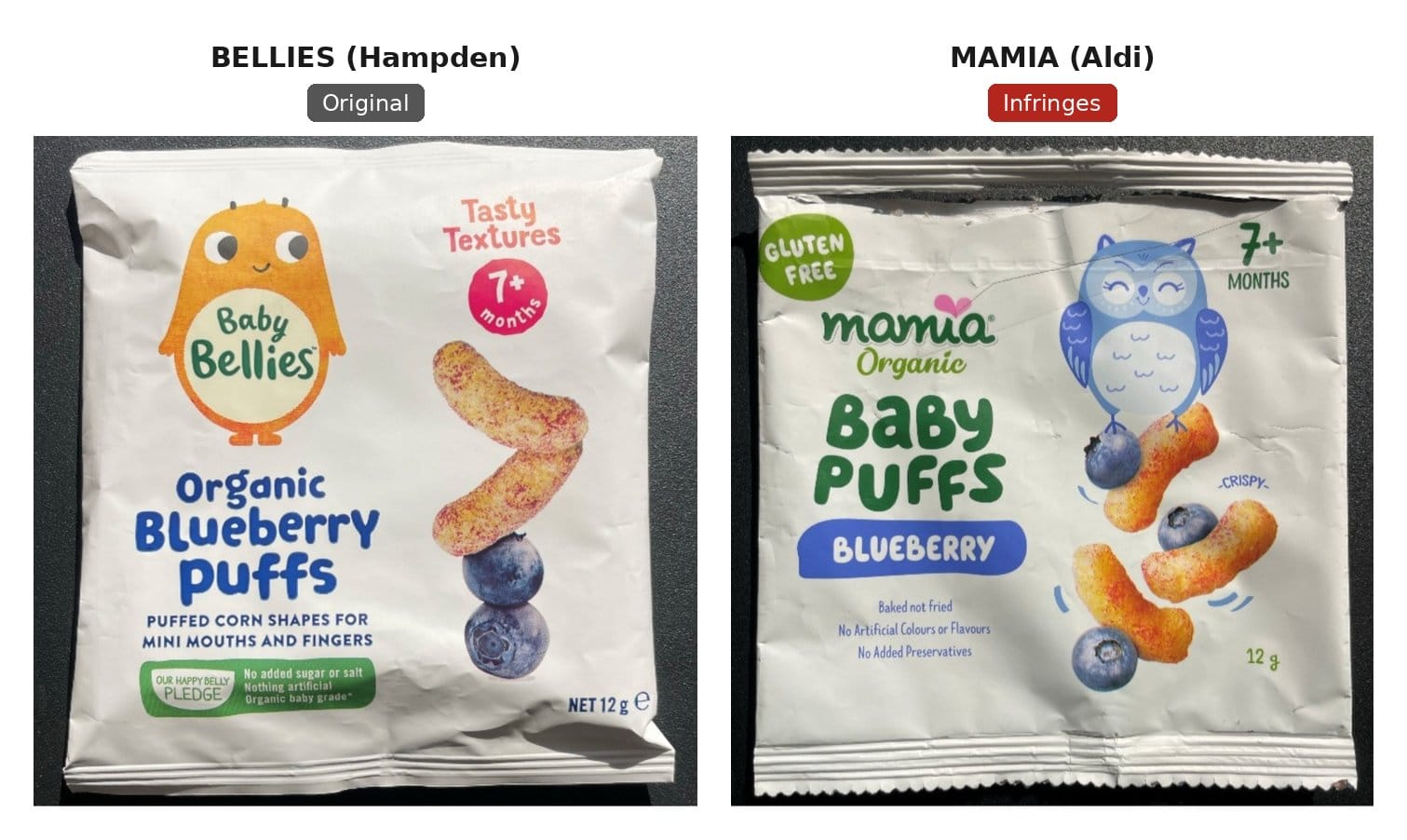
For everyone else, the most useful part of the judgment is how the court said the comparison should be done. The trial judge had reduced the BELLIES design to a list of general features, such as "a small oval-shaped cartoon character" or "a two-column layout." He then checked whether each Aldi pack had them. The Full Court said this was the wrong method. Describe features generally enough and real differences disappear. Describe them rigidly enough and real similarities get missed.
The right approach is a detailed side-by-side comparison of one specific pack against one specific pack, looking at all the similarities and differences. The court then asks a qualitative question: has an important part of that particular artwork been taken, having regard to how original that part is?
What tipped the balance
The court's reasons show which features did the work:
- The food photography. On the puffs packs, Aldi's photos of blueberries and puffs were close enough to amount largely to a reproduction of that part of the BELLIES pack. The court tied this back to Aldi's brief to "follow Baby Bellies with real photography."
- The mascot's belly. Aldi used owls, not monsters, so the character as a whole was not copied. But the owls shared the distinctive light-coloured round belly with writing in it, which the court called an original and prominent feature with no evidence of anything like it elsewhere in the market.
- Colour and font. Identical shades of green, a similar palette and a very similar child-like font all added up.
- The combination. Aldi showed that white backgrounds, age indicators in the corner, fruit photos and playful characters were common in children's food packaging. The court accepted that a white background or an age indicator carries little weight on its own. But nobody else had this particular combination, and the evidence of other packs mainly showed how many other ways Aldi could have designed its own.
- Evidence of the design process. The designer gave detailed evidence of the market review, rounds of concepts and client feedback, and the reasons behind the choices of colour, font, photography and mascot. That evidence showed the originality Aldi had taken, and the trial judge was wrong not to engage with it.
How close the line is shows up best in two of Aldi's fruit and oat bar packs. They are almost identical, apart from the flavour and the colour of the owl. The orange owl pack infringed. The pink owl pack did not. The court said the owl's colour was a significant element, and the orange owl was a material reason the apricot pack was (just) similar enough to infringe.
Copyright protects your artwork, not your "look and feel"
This case is not a licence to stop anyone using a similar style. The Full Court was direct: copyright does not protect a style or get-up. It protects a particular form of expression, meaning the specific artwork on a specific pack.
Hampden argued that one "look and feel" ran across its whole range and that Aldi had taken it. The court rejected that approach. Each pack is a separate artistic work and has to be compared separately. Trying to pull a common look out of a range of different packs is the kind of reasoning that belongs in a misleading conduct case, not a copyright case.
Changes do not automatically save a copier, though. Once the important parts of a work have been taken, it does not matter that the copier also added new things of its own. Where there is evidence of deliberate copying, the court may also see the changes as an attempt to disguise it.
Why this was a copyright case, not a trade mark case
The MAMIA and BELLIES names are nothing alike. Hampden did not need to show that shoppers were confused. That is the practical strength of copyright for packaging:
- It arises automatically when the artwork is created. There is nothing to file and nothing to pay.
- It does not depend on proving shoppers were confused or misled.
- It protects the artwork even where the competing brand name is completely different.
Copyright has limits, as this case shows. You need to own it and prove copying. It only protects the particular artwork, and a close case can turn on the colour of a mascot. A registered trade mark protects your brand name and logo across the goods you register, whether or not anyone copied you. Consumer law can help where a competitor's overall get-up is likely to mislead shoppers. For most product businesses, copyright in the packaging and a registered trade mark for the brand work best together.
If you are the brand being copied
Hampden won on the strength of its evidence, and lost some packs through the way it ran its case. Both are lessons.
- Make sure you own the artwork. BELLIES was designed by an outside studio, and ownership and the right to sue were argued at trial. If an agency or freelancer designed your packaging, check that your agreement assigns the copyright to your business in writing.
- Keep your design history. Briefs, concept rounds, feedback and the reasons behind design choices are the evidence of originality the Full Court relied on. Ask your agency to keep them, or hand them over.
- Compare pack against pack. Pair each competing pack with your closest matching pack. On the bars and rice cakes packs, Hampden limited its appeal to comparisons with just two of its own packs. The court said that for some Aldi packs a different BELLIES pack would have been the obvious match. That choice may have cost it.
- Act early and in writing. A letter of demand puts the other side on notice. Continuing to sell afterwards counted against Aldi.
- Be careful with threats. Aldi claimed Hampden's letters were unjustified threats. That claim failed, but it shows a demand letter needs to be well founded. Get advice before you send one.
- Register your trade marks. Copyright covers the artwork. Your brand name and logo need their own protection.
If you are the one benchmarking
Looking at category leaders is normal. The problem is what happens between the benchmark and the finished pack.
- Watch what your brief says. "Follow Baby Bellies with real photography" and "too close to our benchmark" ended up quoted in the judgment. Brief your designer on your own brand, your customer and the category conventions instead.
- Aiming to stay just on the right side of the line is risky. Aldi's intention not to infringe did not help once the packs were objectively too close. The court also said that deliberately getting close to a competitor for commercial gain is itself flagrant conduct that can justify additional damages.
- Do not count on tweaks. Aldi swapped the monster for an owl, moved the brand name and changed the text. Five packs still infringed.
- Take a letter of demand seriously. Get advice quickly, and consider changing the packaging while you work out your position.
- Get a pre-launch review. A side-by-side check of your proposed pack against the products you looked at costs far less than reprinting, pulling stock and running a case through a trial and an appeal.
Key takeaways
- Your packaging artwork is protected by copyright automatically, and a different brand name will not save a copier.
- Courts compare one specific pack against another, side by side, and ask whether an important and original part of the artwork was taken.
- Copyright does not protect a style, a get-up or a range-wide "look and feel." Common elements count for little on their own, but a distinctive combination can be protected.
- Deliberately designing close to a competitor can be flagrant, even if you meant to stay within the law.
- Own your artwork through a written assignment, keep your design records, and register your trade marks.
Launching a new pack, or worried a competitor has copied yours? Talk to Plumlaw about a fixed-fee packaging and brand review.